
If you run Microsoft Advertising automated bidding strategies such as Maximize Conversions or Target ROAS, your campaigns are getting a new engine without you touching a setting. On November 18, 2026, Microsoft Advertising announced what it calls its biggest upgrade to bidding models in a decade, rebuilding the prediction model that decides whether a click will become a sale and how much that sale is worth.
What changed in Microsoft Advertising automated bidding
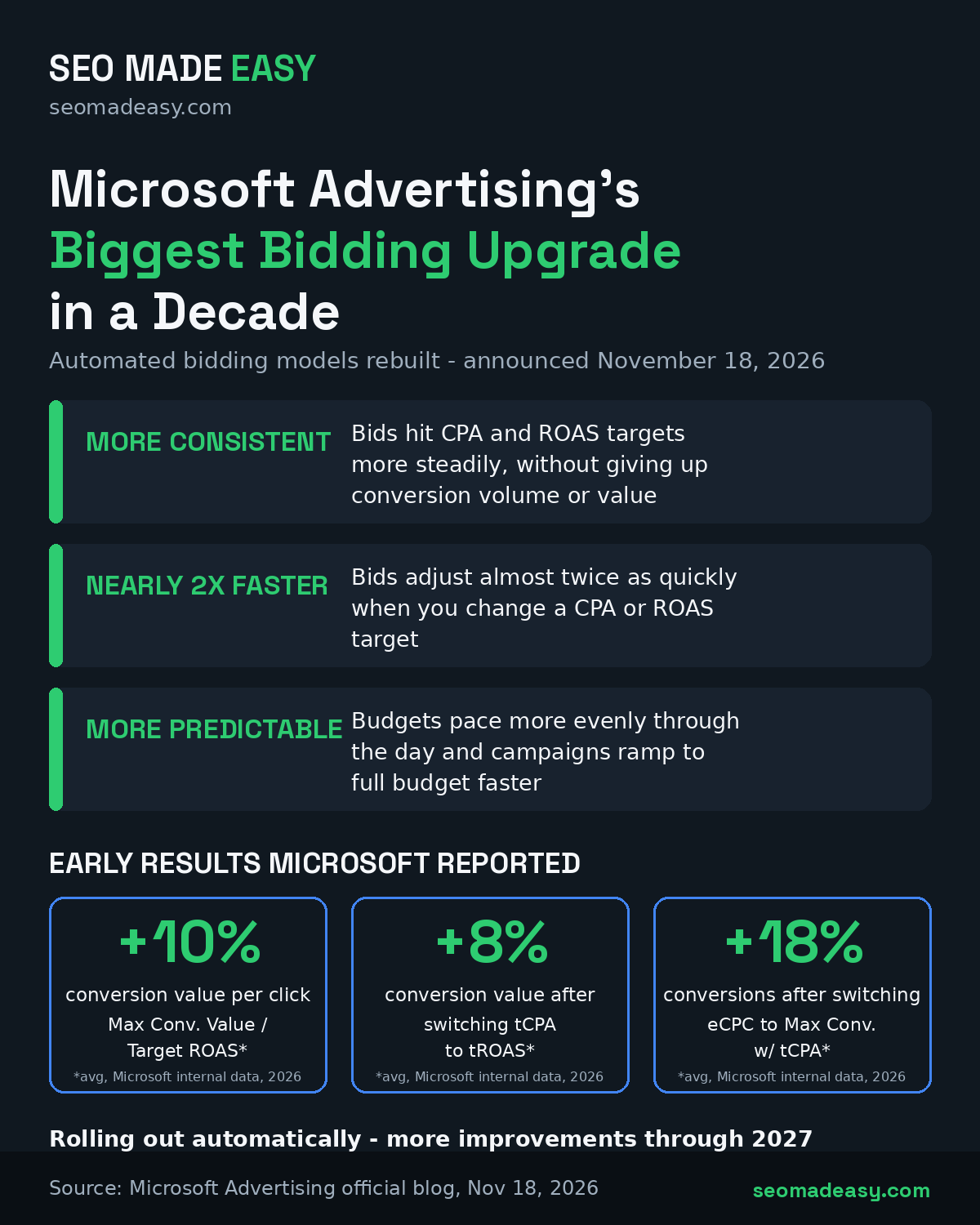
According to the official announcement, the rebuilt bidding models deliver three improvements:
- More consistent performance. Bids meet advertisers’ cost per acquisition (CPA) and return on ad spend (ROAS) targets more consistently, without giving up conversion volume or value.
- Faster optimization. Bids adjust nearly twice as quickly when advertisers update a CPA or ROAS target.
- More predictable delivery. Budgets pace more evenly throughout the day, and campaigns ramp to full budget faster.
Microsoft says every bid depends on predicting whether a click will convert and what that conversion is worth, and that it rebuilt that prediction model with new user signals and a better way of valuing each conversion.
The early numbers Microsoft reported
- Advertisers using Maximize Conversion Value or Target ROAS saw on average 10% more conversion value per click at a similar ROAS (Microsoft internal data, global, Search and Audience Network, August 2026).
- Advertisers who switched Search campaigns from Target CPA to Target ROAS saw on average 8% greater conversion value while maintaining a similar ROAS (internal data, August to September 2026). Microsoft notes the greatest improvements came when advertisers optimized using actual transaction values, such as purchase revenue.
- Advertisers who switched from eCPC to Maximize Conversions with a CPA target saw on average 18% more conversions at a similar cost per action (internal data, June to July 2026).
These are Microsoft’s own internal averages across its network, not guarantees for any single account. Treat them as directional evidence that value-based bidding is where the platform is investing.
What advertisers should do now
Microsoft paired the announcement with specific best practices:
- Set up healthy conversion tracking. Automated bidding optimizes toward conversions, so without the right signal there is nothing to optimize. Microsoft recommends Universal Event Tracking (UET) because it provides richer, more granular signals, with Conversions API and offline import extending coverage across apps, CRMs and stores. Our earlier piece on Meta’s on-device conversion measurement change covers the same signal-quality theme on the Meta side.
- Choose the right bid strategy. For new campaigns, if your account has at least five conversions, Microsoft recommends starting on a conversion-based bid strategy right away rather than Enhanced CPC, because account-level conversion history feeds bidding signals to every campaign. Accounts with fewer than five conversions can start with eCPC to gather history first.
- Adjust targets gradually. Large target CPA increases or ROAS decreases open up new inventory, so expect short-term volatility while the system calibrates. Microsoft suggests making changes in 15% increments and reviewing after one conversion cycle.
- Drop Maximum CPC caps. Microsoft says keeping a Maximum CPC set is not recommended, because caps override CPA and ROAS targets with conflicting instructions. Manage performance through budgets, bid targets and conversion value rules instead.
- Evaluate at the right level. Judge performance after accumulating sufficient conversions, ideally 30 conversions in 30 days, and wait one to two conversion cycles after major changes. Evaluate at the campaign or portfolio level, not by keyword-level CPCs.
One platform detail worth knowing: unlike some competitors, Microsoft Advertising lets campaigns overachieve on target CPA or target ROAS regardless of budget-limited status. Targets act as directional levers rather than rigid caps.
If you split budget across platforms, our guide to online advertising platforms for small business budgets explains where Microsoft Ads fits next to Google and Meta, and our coverage of Google Ads Editor 2.14 turning on AI Max by default tracks the parallel automation push on Google’s side.
Availability: who gets it and when
The upgrade rolls out automatically, so there is nothing to enable. Microsoft describes it as the first stage of a longer program, with improvements reaching more accounts over time and more to come in 2027. There is no regional restriction: advertisers in the US, UK, India, Dubai and the wider Gulf all run on the same upgraded models. Because the reported averages come from global internal data, individual results will vary by account and market.
Frequently Asked Questions
Do I need to change my campaigns for the new Microsoft Ads bidding models?
No. The upgrade rolls out automatically to accounts, with no settings to enable. Microsoft calls this the first stage, with further improvements rolling out over time and more planned for 2027.
Should I switch from Target CPA to Target ROAS on Microsoft Advertising?
Microsoft’s internal data shows advertisers who switched Search campaigns from Target CPA to Target ROAS saw on average 8% greater conversion value at a similar ROAS. The company says the strongest gains come when you optimize with actual transaction values, such as purchase revenue, so accurate value tracking matters more than the switch itself.
Are Maximum CPC caps still a good idea?
Microsoft says no. It describes Maximum CPC settings as conflicting instructions that override your CPA or ROAS targets, and recommends managing performance through budgets, bid targets and conversion value rules instead.
How long should I wait before judging the new bidding performance?
Microsoft recommends evaluating after roughly 30 conversions in 30 days, waiting one to two conversion cycles after major changes, and judging at the campaign or portfolio level rather than by keyword-level CPCs.
Sources: Microsoft Advertising: Building the next generation of automated bidding (November 18, 2026); Search Engine Land coverage (November 18, 2026).
1 Comment