ChatGPT’s business agents are going international. OpenAI’s Business Hub help page, updated on November 26, now says eligible ecommerce and online service businesses can claim their business and publish a ChatGPT business agent “where ChatGPT is available and the required verification is supported” – no longer limited to the US. When Business Hub launched on November 10, the program was US-focused; the updated documentation is the first official word that online businesses elsewhere can take part.
What changed for ChatGPT business agents
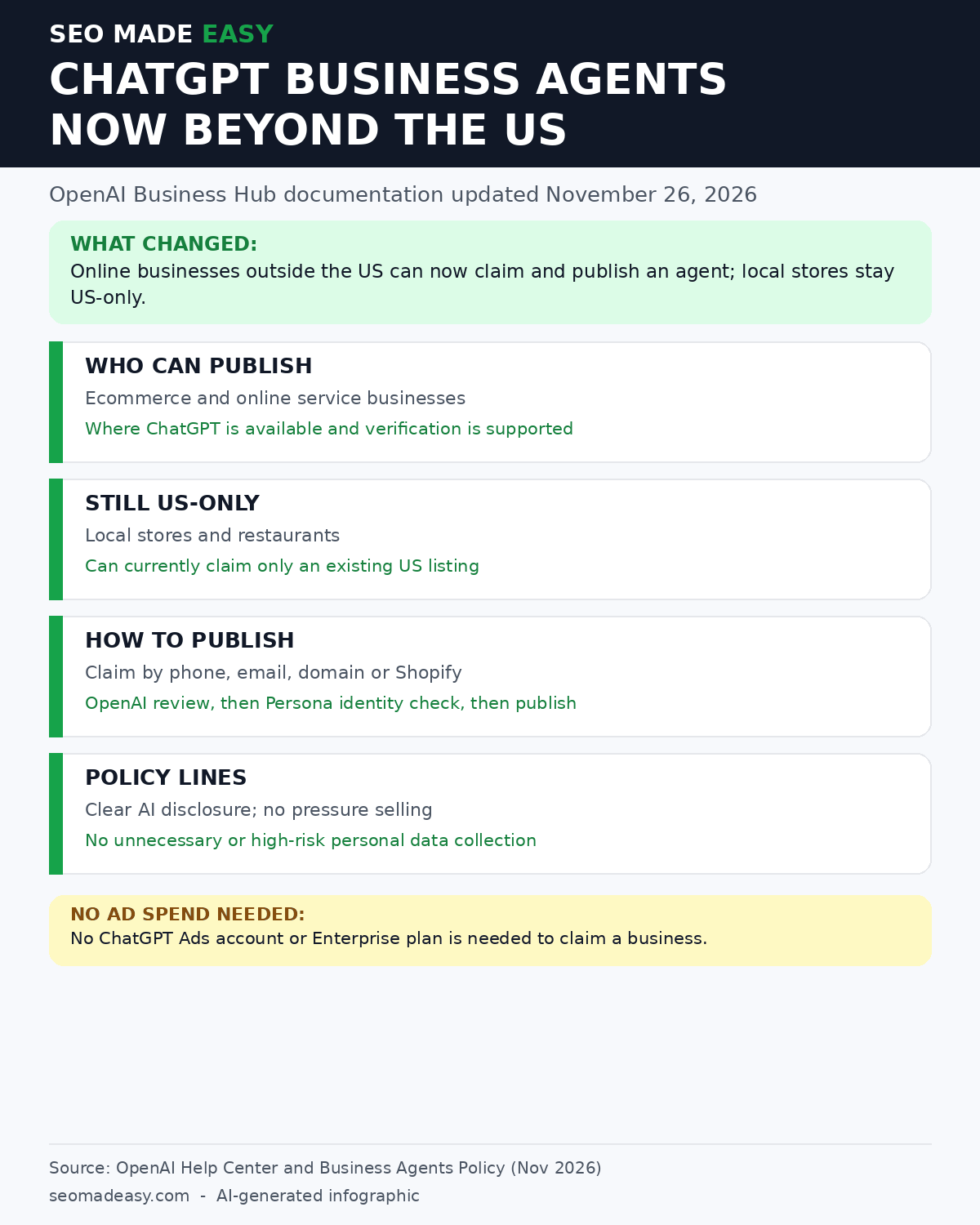
A business agent is a conversational AI, built in Business Hub, that answers customer questions about a company’s products, services and policies using information the business provides. The November 26 documentation update confirms that eligible ecommerce and online service businesses can create and publish one outside the US. Availability still depends on the business’s location and type, and OpenAI has not published a country list. One boundary is explicit: local stores and restaurants can currently claim only an existing US listing, so the opening applies to online businesses, not physical ones.
Who is eligible to publish an agent
Three gates apply. First, the business type: ecommerce and online service businesses are eligible, and the business must meet the industry requirements in OpenAI’s Business Agents Policy. Second, authority: you must own the business or be authorized to represent it, and prove it through verification. Third, policy review: OpenAI says it considers both the business category and the agent’s intended use before allowing publication, and that business verification alone does not guarantee agent eligibility. You do not need a ChatGPT Ads account or an Enterprise agreement to claim a business.
How claiming and verification work
The process has four steps, all documented in the help page. You claim the business in Business Hub by searching for its name – or adding it if you run an eligible online business that is not listed – and verifying the connection by business phone, business email, website domain (a DNS TXT record) or Shopify. OpenAI then reviews the claim and emails its decision. After approval, you complete identity verification with Persona (OpenAI’s verification partner), which may ask for a government-issued ID and business registration details; only after Persona approves can you publish changes, view insights, connect a product feed or publish an agent. The blue verified badge appears after Persona approval, not before.
What the rules allow an agent to do
The Business Agents Policy sets clear behavioral lines. The agent must be presented as AI representing the business, not a human or independent adviser. It must not pressure people, create false urgency, or keep selling after someone declines. It may offer an optional follow-up and collect contact details through an approved feature when the user chooses, but it cannot ask for unnecessary or high-risk personal information – health details, government IDs, financial credentials – or submit a form, booking or purchase on the user’s behalf without explicit authorization through an approved feature.
What businesses in India, the Gulf and elsewhere should do
If you run an ecommerce or online service business outside the US – including in India, Dubai or the wider Gulf – this update means the program is no longer documented as US-only for online businesses. It is not a confirmation for any specific country: OpenAI has published no country list, so regional eligibility stays unconfirmed until the claim flow shows a supported verification method for your business. The practical step is to open Business Hub in ChatGPT, search for your business, and see which verification methods it offers. Physical stores and restaurants outside the US are not included yet. For businesses already advertising on the platform, this pairs naturally with the campaign side we covered in ChatGPT Ads’ bidding changes.
Frequently Asked Questions
Can a business in India or the UAE create a ChatGPT business agent?
Not confirmed yet. OpenAI’s documentation no longer restricts agent publishing to the US for eligible ecommerce and online service businesses – it says businesses can claim and publish where ChatGPT is available and the required verification is supported – but it publishes no country list, so eligibility for India or the UAE specifically is unconfirmed until your claim flow shows a supported verification method. Local stores and restaurants can currently claim only an existing US listing.
Do I need ChatGPT Ads or an Enterprise plan to claim my business?
No. OpenAI’s help page says you do not need an Ads account or a ChatGPT Enterprise agreement to claim an eligible business. You do need to verify your connection to the business and complete identity verification with Persona before publishing anything.
What verification does OpenAI require for Business Hub?
Two stages. Claim verification proves your connection to the business by phone, business email, website domain (DNS record) or Shopify, followed by OpenAI’s review. Persona identity verification then confirms who you are, using documents such as a government-issued ID and business registration information. The verified badge appears only after Persona approval.
Can a ChatGPT business agent take orders or collect customer data?
Not on its own initiative. OpenAI’s policy allows an agent to collect contact details only through an approved feature when the user chooses to provide them, and it cannot submit a form, booking or purchase without explicit authorization through an approved feature. Asking for unnecessary or high-risk personal information is prohibited.
Sources: OpenAI Help Center: Setting up your business on ChatGPT (updated November 26, 2026), OpenAI Business Agents Policy, and Introducing Businesses in ChatGPT (November 10, 2026).