
Google has finally written the manual. On November 24 it added a page to Search Central titled Control how your content is used for generative AI at Google, along with a companion page on how AI features pick and check their sources. For anyone deciding how their site appears in AI Overviews and AI Mode, the new generative AI controls documentation answers questions that until now were scattered across robots.txt references and help pages.
Training and grounding are separate switches
The most useful clarification is a clean split between two uses. Training teaches future foundation models (like Gemini) before deployment. Grounding is when an already-deployed model looks up fresh pages from the Search index to answer a prompt – the retrieval step behind AI Overviews and AI Mode. Google stresses these are “completely independent”, and its controls reflect that: you can limit one without touching the other.
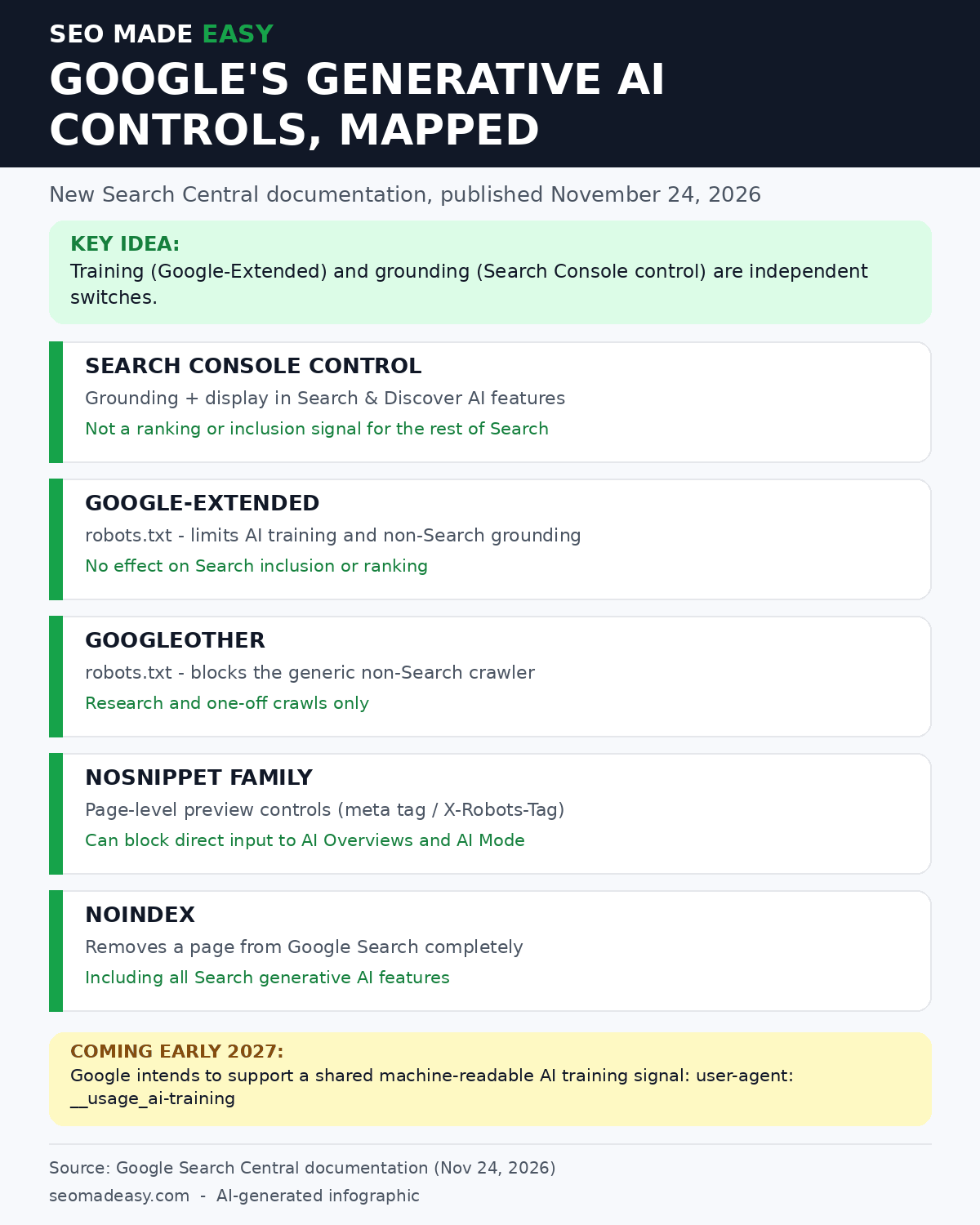
The generative AI controls Google documents
- Search generative AI control (set in Search Console): manages whether your content is used for grounding or shown, including links, in generative AI features on Search and Discover, such as AI Overviews and AI Mode. Google states it does not affect model training and “isn’t used as a ranking or inclusion signal for other parts of Google Search”.
- Google-Extended (robots.txt): limits training and grounding for Google’s non-Search generative AI products. Google says it “is not used as a ranking signal in Search and doesn’t affect a site’s inclusion in Search”.
- GoogleOther (robots.txt): blocks Google’s generic crawler for non-Search uses such as research crawls, without affecting Search.
- nosnippet, max-snippet and data-nosnippet (page HTML or X-Robots-Tag): page- and text-level preview controls that also work in AI Overviews and AI Mode; nosnippet and max-snippet can prevent content being used as a direct input for those features.
- noindex: removes a page from Search entirely, including Search generative AI features.
That middle point matters. The fear that opting out of AI answers quietly costs rankings has hung over every opt-out discussion – including the regulatory ones we covered in Turkey’s AI Overviews opt-out order. Google has now stated in its own documentation that the Search Console control is not a ranking or inclusion signal elsewhere in Search.
Which control should you use?
Google includes a recipe table matching goals to settings. The common cases: to stay in Search and AI training but opt out of AI Overviews and AI Mode, set the Search generative AI control to exclude and leave Google-Extended alone. To stay fully in Search but limit AI training and non-Search grounding, disallow Google-Extended in robots.txt. To do both, combine them. For paywalled content that should keep a visible snippet in AI answers, Google suggests paywalled structured data combined with data-nosnippet or max-snippet.
One forward-looking note: Google says it “intends to support the shared machine-readable training preference signal (with user-agent: __usage_ai-training) in early 2027” – a standard robots-style signal for AI training preferences. That is an intention, not a launched feature, but it is worth watching if training consent matters to your business.
How AI Overviews and AI Mode pick their links
The companion page, Attribution and factuality in Search generative AI features, explains the pipeline: AI Overviews start from ranked Search results, may run related “query fan-out” searches for sub-questions, ground the response in the retrieved pages, and cite the pages that support each claim. Google says responses go through automated checks before display – including corroboration against top web results and a higher bar for sensitive topics – and that display formats (inline icons, source cards, carousels) balance relevance and quality signals from Search ranking. Practically: the same fundamentals that rank pages in Search feed the AI features, which is the working approach in our guide to getting into AI answers.
What this means for site owners
There is nothing to fix here – this is documentation, not a policy change, and Google has not altered how the controls work. What changes is that the rules are now written down in one place, with Google’s own wording on ranking effects. If you have been holding back from the Search Console control out of ranking anxiety, the official answer is now documented. If you operate in multiple markets, remember the controls are yours to set regardless of region, while regulators in Turkey and the UK are separately turning some of these choices into legal obligations for Google.
Frequently Asked Questions
Does opting out of AI Overviews hurt my Google rankings?
For the Search Console control, no: Google’s documentation says it “isn’t used as a ranking or inclusion signal for other parts of Google Search”, and that Google-Extended is not a ranking signal either. That control only removes your content from the generative AI features themselves. Other controls are broader by design, not hidden penalties: nosnippet and max-snippet limit previews across Search, and noindex removes a page from Search completely.
What is the difference between Google-Extended and the Search generative AI control?
Google-Extended, set in robots.txt, limits AI model training and grounding for Google’s non-Search products such as the Gemini app. The Search generative AI control, set in Search Console, governs whether your content grounds or appears in Search and Discover AI features like AI Overviews and AI Mode. They work independently and can be combined.
Can I block AI training but stay in AI Overviews?
Yes. Google’s recipe table says to disallow Google-Extended in robots.txt while leaving the Search generative AI control off – that limits training and non-Search grounding without affecting your presence in Search, AI Overviews or AI Mode.
What is the __usage_ai-training signal coming in early 2027?
It is a shared machine-readable preference signal for AI training, declared in robots.txt-style syntax as user-agent: __usage_ai-training. Google says it intends to support it in early 2027; it is not live yet.
For daily SEO news and Google algorithm update coverage, follow the SEO news and updates stream.
Sources: Google Search Central: Control how your content is used for generative AI at Google and Attribution and factuality in Search generative AI features (both added November 24, 2026, per the Search Central documentation changelog).