
The Ultimate Guide to Content Marketing for Small Businesses in 2026
Content marketing is the strategic creation and distribution of valuable, relevant content to attract and retain a clearly defined audience — ultimately driving profitable customer action, without hard selling. For small businesses in 2026, it remains the most cost-effective way to build trust and generate leads.
Small business owners often hear that content marketing is essential, but knowing where to start — and what actually works on a limited budget — can be overwhelming. This guide walks you through the proven framework for 2026, covering strategy, execution, costs, and common pitfalls, so you can grow your brand without an agency.
Why Content Marketing Still Works for Small Businesses in 2026
Content marketing continues to deliver strong returns because it aligns with how modern buyers research and decide. When someone searches for a solution to their problem, they’re not looking for a sales pitch — they want helpful information. By providing that information, you build authority and trust long before they’re ready to buy.
For small businesses, the advantage is even greater. Unlike paid ads that stop working the moment you stop spending, content assets like blog posts, videos, and guides can generate traffic and leads for months or years. A single well-optimized article can bring in dozens of qualified leads every month without recurring costs.
That said, content marketing isn’t instant. Many beginners expect results in weeks and give up too soon. Realistically, you should plan for 6 to 12 months before seeing consistent organic traffic from search engines. The payoff comes from patience and consistent effort, not quick wins.
In 2026, Google’s search algorithms place even more weight on expertise, experience, authoritativeness, and trustworthiness (E-E-A-T). This means content written by someone with real knowledge — or at least thoroughly researched — ranks higher than generic AI-generated fluff. Small businesses can lean into their niche expertise as a competitive edge.
What Does a Content Marketing Strategy Look Like for a Small Business?
A content marketing strategy is your roadmap: it defines who you’re creating content for, what problems you solve, and how you’ll distribute that content. Without a strategy, you’ll waste time creating posts that don’t connect with anyone or drive business results.
Start by defining your target audience. Instead of a broad demographic like “small business owners,” narrow it down: “freelance graphic designers who struggle to get clients on LinkedIn.” The more specific, the better your content will resonate. Then, identify their biggest questions and pain points — these become your content topics.
Next, decide on content formats. Blog posts are the foundation because they’re cheap to produce and excellent for SEO. But video and audio are growing fast: a short explainer video or a 10-minute podcast episode can reach audiences who prefer consuming content differently. Choose one or two formats you can consistently deliver rather than spreading too thin.
A common mistake small businesses make is skipping the distribution plan. You can write the best article in the world, but if no one sees it, it’s useless. Plan to share each piece on social media, in your email newsletter, and — if budget allows — with a small paid boost to your best-performing content. Repurpose a single blog post into social snippets, an email summary, and a short video to maximize effort.
How to Create High-Quality Content That Actually Ranks in 2026
Creating content that ranks requires more than just writing about a topic. You need to satisfy search intent — what the user actually wants when they type a query. If someone searches “how to write a press release,” they want step-by-step instructions, not a definition. Match your content format to the intent: listicles for comparisons, guides for how-tos, and opinion pieces for brand-building.
Keyword research is still critical, but in 2026 it’s not just about volume. Short-tail keywords (like “content marketing”) are highly competitive. For small businesses, long-tail keywords (like “content marketing for freelance web developers”) are more achievable and often convert better because they target users further along in the buying journey.
When writing, structure your content for readability. Use short paragraphs, bullet points where appropriate, and clear subheadings that answer specific questions. Google’s featured snippets and AI overviews often pull from well-organized content that directly answers a question. The direct-answer paragraph at the top of this guide is an example of that approach.
- Match format to intent: List posts for comparisons, step-by-step guides for how-tos, in-depth articles for brand-building.
- Focus on long-tail keywords: They are less competitive and more likely to convert, e.g., “content marketing for freelancers” instead of “content marketing.”
- Structure for readability: Use short paragraphs, subheadings, and bullet points to improve both user experience and search visibility.
- Add unique insight: Include personal experience, specific examples, or lessons learned that AI cannot easily replicate.
Avoid the temptation to use AI-generated content without human editing. As of 2026, Google can detect AI-written text that lacks real depth or unique insight. Small businesses should use AI tools for brainstorming and outlines, but the final content should reflect your personal experience or thorough research. Include specific examples, lessons learned, and honest advice that a machine couldn’t invent.
How Much Does Content Marketing Cost for a Small Business?
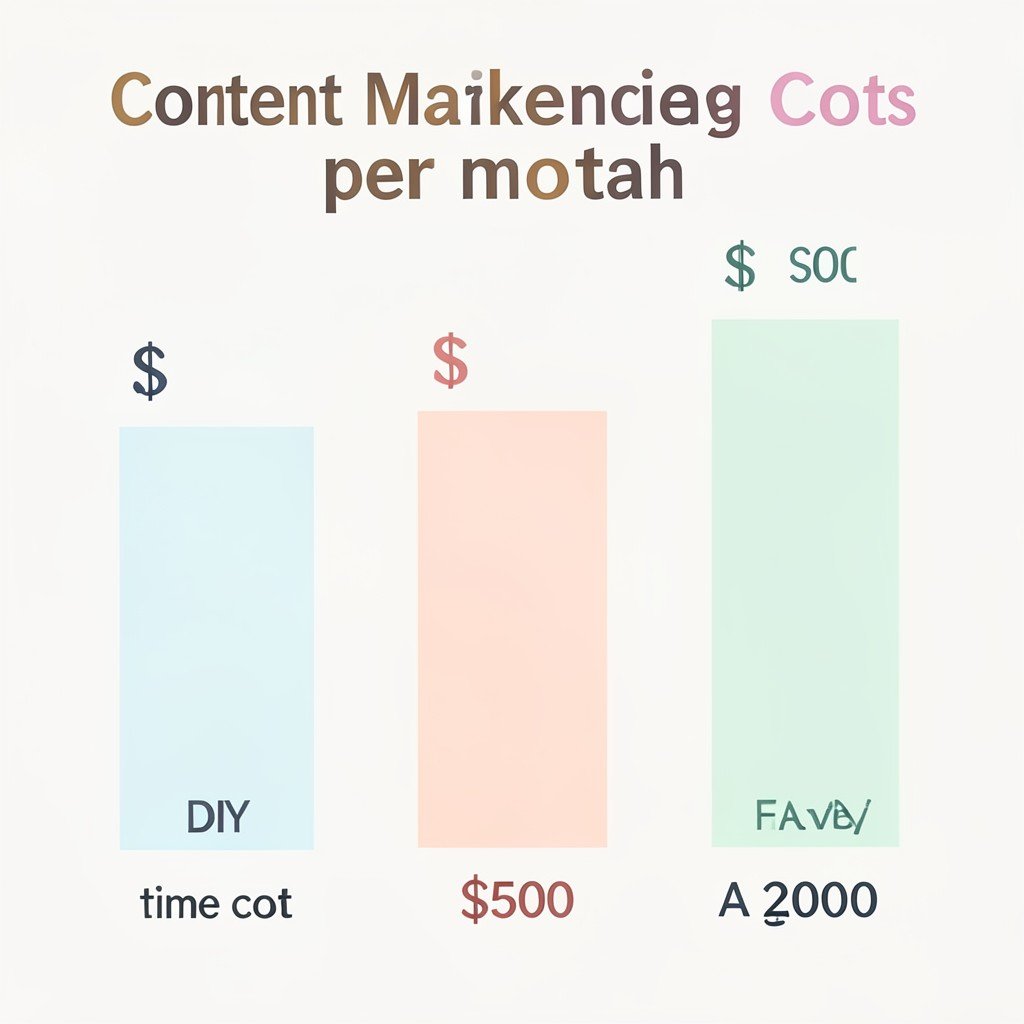
Content marketing can range from nearly free to several thousand dollars per month, depending on your approach. The cheapest route is creating everything yourself — your time is the biggest cost. Writing a 1,500-word blog post might take a beginner 3–5 hours, while an experienced writer might finish in 1–2 hours. If you value your time at $50/hour, each post costs you $50–$250 in opportunity cost.
If you outsource, freelance writers typically charge $100–$500 per blog post, depending on expertise and topic complexity. Video content costs more: a simple talking-head video might cost $200–$1,000 per minute for professional production. Expect to pay more for industry-specific topics that require subject matter expertise.
On top of content creation, you’ll need tools. A basic SEO tool like Ahrefs or Semrush costs about $100–$200 per month. Email marketing software starts free but scales to $20–$50 per month as your list grows. A social media scheduler like Buffer or Hootsuite is around $10–$50 monthly. Total monthly investment for a serious solo effort: roughly $200–$500 plus your time.
Many small business owners try to cut costs by skipping SEO research or distribution. This is a mistake. Without keyword research, your content won’t be found. Without distribution, it won’t be seen. Invest proportionally — put 30% of your budget into research and planning, 40% into creation, and 30% into promotion. That split keeps your strategy balanced.
What Are the Biggest Content Marketing Mistakes Small Businesses Make?
- No clear goal: Each piece should have one primary objective (e.g., drive traffic, generate leads, build authority) with a relevant call-to-action.
- Overly promotional: Focus 90% on helping, 10% on soft promotion. Build trust before selling.
- Inconsistency: Sporadic posting trains no audience and hurts SEO. Aim for one quality blog post per week plus daily social updates.
- Ignoring analytics: Track traffic, engagement, and conversions. Double down on what works, drop what doesn’t.
Another common error is being too promotional. Content marketing works when the reader feels they learned something valuable — not when they feel sold to. Focus 90% of your content on helping, and only 10% on soft promotion. Over time, readers will trust you and become customers naturally.
Inconsistency is a silent killer. Posting five articles one month and nothing for two months trains no audience and sends poor signals to search engines. A sustainable schedule — like one high-quality blog post per week plus one social post per day — is better than bursts of activity followed by silence. Use a content calendar to stay on track.
Finally, ignoring analytics means you can’t improve. Many small businesses publish and hope for the best. Instead, track which topics drive traffic, which formats get engagement, and which calls-to-action convert. Double down on what works, and stop doing what doesn’t. Even simple data from Google Analytics and your email platform can reveal clear patterns within three months.
How to Distribute and Promote Your Content Effectively

Creating great content is only half the battle — promotion determines whether it succeeds or gathers dust. Start with your owned channels: email list and social media. Your email subscribers are your most engaged audience, so send a weekly or biweekly newsletter highlighting your latest content. Social media posts should use platform-appropriate formats: short text plus image for Instagram, a question or hook for Twitter, and a longer post with a link for LinkedIn.
Beyond your own channels, consider strategic partnerships. Guest posting on other small business blogs in your niche can bring referral traffic and backlinks. Look for sites that accept guest contributions and pitch topics that their audience will find useful. Similarly, participating in online communities like Reddit, Facebook Groups, or LinkedIn Groups — where you share your content only when it directly answers a question — builds your reputation.
Paid promotion can amplify your best content. A small budget — say $100–$300 per month — on Facebook Ads or Google Ads aimed at a targeting interest can stretch far if you promote your top-performing organic posts. Use the data from your analytics to identify posts that already get engagement, then boost them to a wider audience.
Repurposing is the most underutilized promotion tactic. Turn a single blog post into a 5-minute YouTube video, a podcast episode, an infographic, and 3–4 social media posts. Each format reaches a different segment of your audience. Over time, you build a library of content that works across channels, multiplying your effort without multiplying your workload.
Conclusion
Content marketing for small businesses in 2026 is not about viral hacks or overnight success. It’s a long-term investment in building trust, authority, and a steady stream of leads. By understanding your audience, creating genuinely helpful content, and distributing it consistently, you can compete effectively — even against larger competitors — without an agency budget. Start small, stay consistent, measure what works, and adjust as you go.
Frequently Asked Questions
What is content marketing in simple terms?
Content marketing is creating and sharing free, valuable content (like blog posts, videos, or social media updates) to attract potential customers and build trust, rather than directly pitching your product or service.
How long does it take for content marketing to work?
Most small businesses see initial results within 3 to 6 months, but significant organic traffic and lead generation typically take 6 to 12 months of consistent effort. Patience is key.
Can I do content marketing myself without hiring a team?
Yes. Many small business owners start by writing their own blog posts and managing social media. The main investment is time — expect to spend several hours per week on content creation and promotion.
Do I need to post every day for content marketing to work?
No. Quality and consistency matter more than frequency. Posting one well-researched blog post per week plus a few social updates is enough to build momentum for most small businesses.