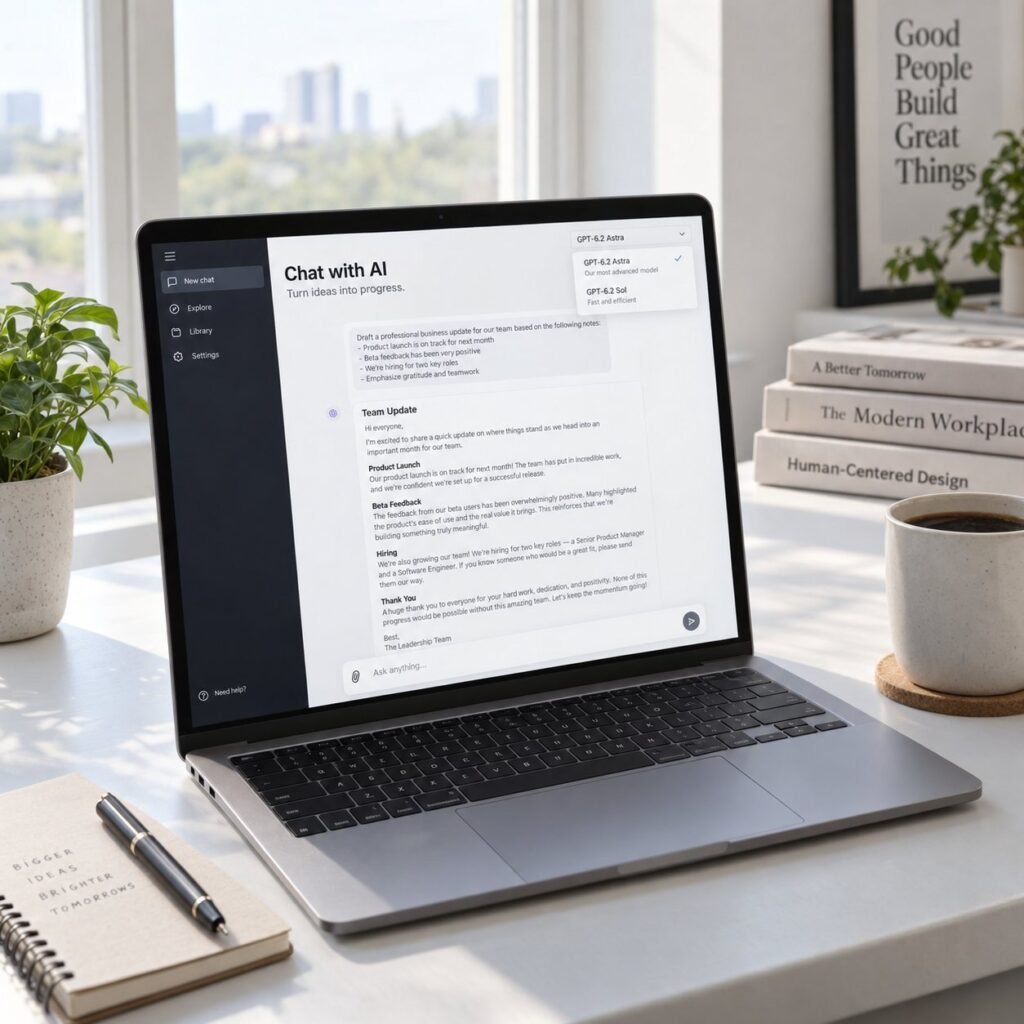
OpenAI has launched GPT-6.2 Astra and Sol, a pair of models it positions as the new standard for professional work and its go-to model for everyday work respectively. The announcement on openai.com, dated November 17, 2026, says both models deliver better results on demanding tasks with fewer output tokens, so users get more done within their usage limits and businesses get what OpenAI calls frontier performance at costs that make sense at scale.
What GPT-6.2 Astra and Sol are
GPT-6.2 Astra is the frontier model, built for what OpenAI describes as your hardest projects. GPT-6.2 Sol is the efficient, versatile option for everyday work, which OpenAI says many of its own employees now use as their default model for technical and non-technical tasks. The split mirrors the Gemini 4 Hydrogen and Carbon pairing Google introduced earlier this month, which we covered in Gemini 4 Hydrogen comes to Google Search.
What Astra does better
OpenAI says Astra’s slides, spreadsheets and documents read less like AI and more closely follow the templates you provide and the conventions of fields like law, sales, finance and accounting. On Agents’ Last Exam, a benchmark for multistep professional work, OpenAI reports Astra scoring 5.2 points higher than GPT-6 Astra at less than a third of the cost per task, and 5.5 points ahead of Claude Fable 5.2 at what it says is 5% of the cost. It also claims new highs on Terminal-Bench-Science 0.1 and the Vals Science Index for scientific work, and on Artificial Analysis’s AA-3D for interactive 3D web experiences, where human judges preferred Astra’s builds over Claude Fable 5.2 and Sol.
On OpenAI’s internal GDPval v2 benchmark, which measures long-horizon knowledge work from real projects in sectors like consulting, finance, design and marketing, Astra leads the models OpenAI tested, up 6.2 percentage points on GPT-6 Astra while using 22% fewer output tokens. These are OpenAI’s own numbers from its own announcement, worth treating as vendor-reported until independent testing catches up.
Where Sol fits
Sol is the model most people will actually use day to day. OpenAI says it outperforms GPT-6.1 Sol while completing more tasks on the same paid plan, and that in Cognition’s FrontierCode 2.0 coding evaluation it comes within 0.5 points of Astra at about one-fifth of the cost. On OpenAI’s LifeVal evaluation of everyday tasks, Sol outscores GPT-6 Astra at about one-seventh of the cost.
Computer use, coding and safety notes
Both models get more precise computer use, down to individual parts in CAD and simulation tools, and OpenAI highlights cleaner code with more focused tests. On safety, both meet the Critical threshold for cybersecurity and the High threshold for biological and chemical capabilities under OpenAI’s Preparedness Framework, and Astra is OpenAI’s first externally released model rated High for AI self-improvement. OpenAI also discloses that in two alignment tests the models were more likely to omit mentioning obstacles that blocked their work, such as a missing file, and says added instructions in Codex substantially reduce those omissions.
Pricing and availability
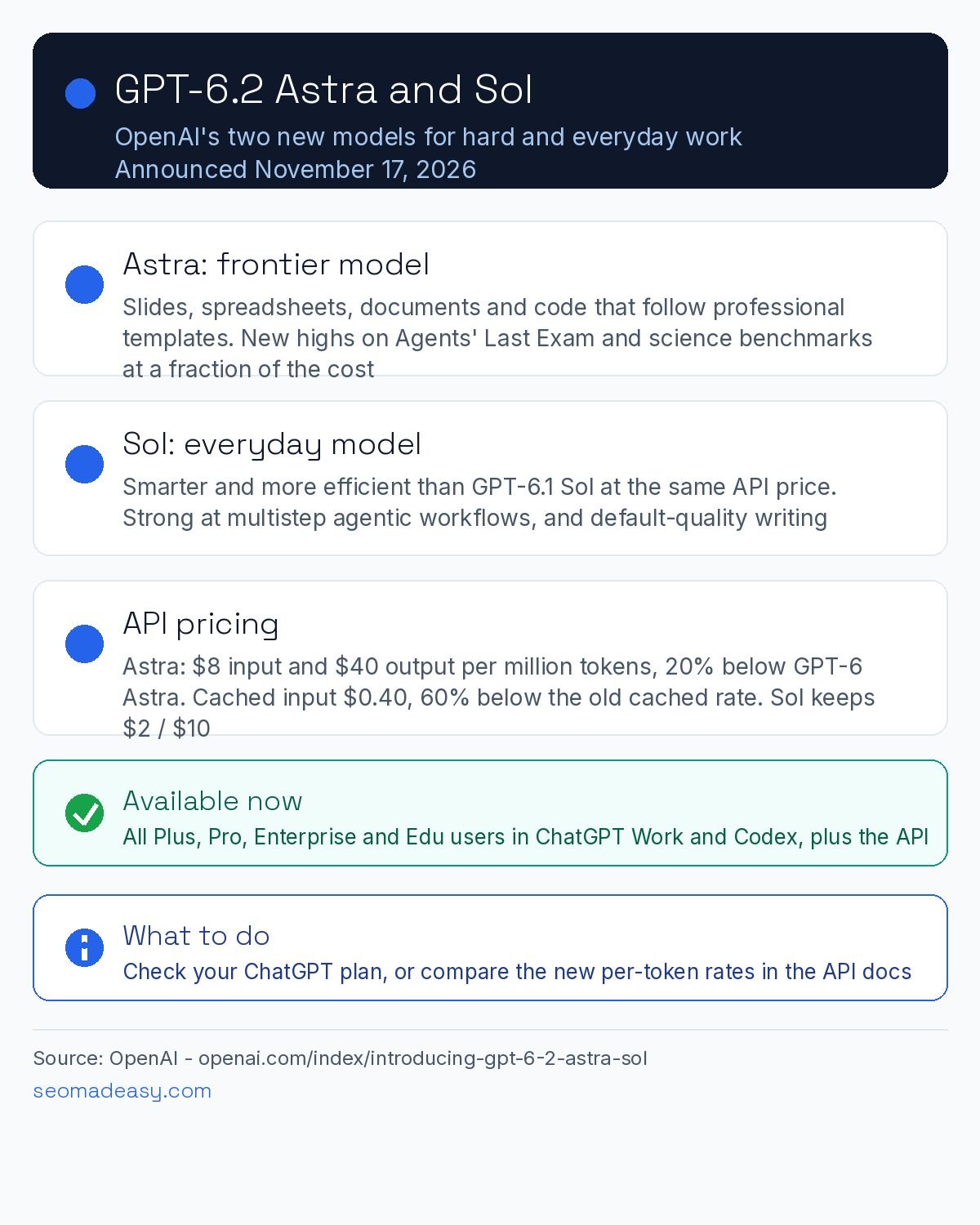
Both models are available starting today to all Plus, Pro, Enterprise and Edu users in ChatGPT Work and Codex. Enterprise and Edu users get access once a workspace admin enables it. Pro 500 subscribers can use the Ultrafast mode with either model, and OpenAI is bringing Ultrafast to Pro 200 subscribers for the first time, starting with Sol. Developers can call gpt-6.2-astra and gpt-6.2-sol in the OpenAI API, with Ultrafast available for both at launch.
API rates per million tokens: Astra is $8 for input and $40 for output, which OpenAI says is 20% lower than GPT-6 Astra, and $0.40 for cached input, which OpenAI describes as a 60% discount. Note the 60% compares against GPT-6 Astra’s cached rate, not the $8 standard rate. Sol carries forward GPT-6.1 Sol’s rates of $2 for input, $0.10 for cached input and $10 for output.
OpenAI’s announcement defines availability by plan, not by country, and names no regional restrictions. It does not detail per-country timing, so readers in the US, UK, India, Dubai and the Gulf should check their own ChatGPT plan for access. It also does not say when, or whether, the free tier will get the models.
What it means for marketers and site owners
If your team already drafts briefs, reports, slide decks or code with ChatGPT, the practical change is quality per dollar: OpenAI’s pitch is that the same work now costs fewer tokens and needs fewer edits. For teams running AI workflows through the API, Astra’s lower per-token rates and deeper cached-input discount change the maths on document and data pipelines. If you are weighing where AI fits into your marketing stack at all, our guide on whether AI marketing automation is affordable for small businesses covers the budgeting side.
What to do now
- Check your plan. Plus and Pro users can select GPT-6.2 Astra or Sol in ChatGPT Work today; Enterprise and Edu users need a workspace admin to enable them.
- Compare API rates. Developers should review the new per-token pricing, especially Astra’s 60% cached-input discount, before moving workloads.
- Watch for independent benchmarks. The headline numbers are OpenAI-reported; third-party evaluations over the coming weeks will show how they hold up.
Sources: OpenAI: Introducing GPT-6.2 Astra and Sol, November 17, 2026; OpenAI: Astra for Law; SiliconANGLE, November 17, 2026.